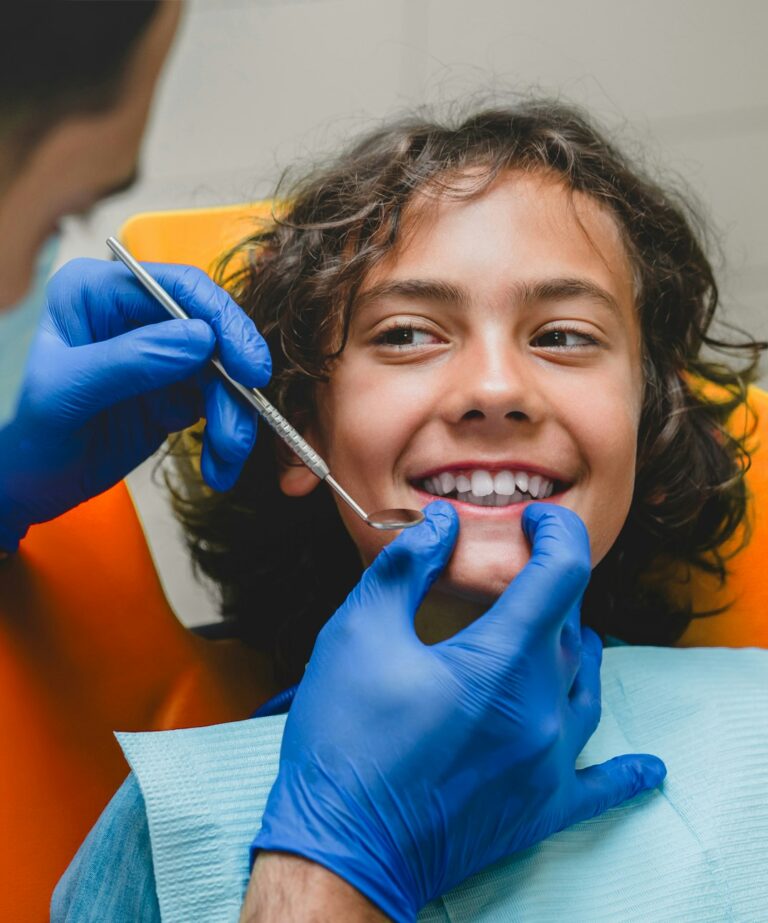

Ectopic eruption means a permanent tooth is coming in out of position. Instead of following its normal path into the mouth, the tooth grows in at an angle, in front of or behind the other teeth, or gets stuck against a neighboring tooth. It is most common in children while baby teeth are being replaced, and it is usually easiest to correct when it is caught early.
Below, we explain what causes an ectopic tooth, the signs parents can watch for, how it is treated, and a real case from our office.
What Is Ectopic Eruption of a Tooth?
Every permanent tooth starts as a tooth bud inside the jaw. As your child grows, each bud is supposed to move along a fairly predictable path, push out the baby tooth above it and settle into its spot in the arch. In an ectopic eruption, that path goes wrong. The tooth may come in sideways, high in the gums, behind the baby teeth or tucked against the root of the tooth next to it.
The word “ectopic” simply means “out of place.” It describes where the tooth is erupting, not how serious the problem is. Some ectopic teeth straighten out on their own once space opens up. Others stay locked in the wrong position and need help from an orthodontist.
Which Teeth Are Most Often Affected?
Ectopic eruption can happen to any permanent tooth, but a few teeth show up again and again. Here is what families commonly see and roughly when it tends to appear.
| Tooth | Typical age it shows up | What it often looks like |
|---|---|---|
| Upper first molars | Around six to seven | The new molar tips forward and catches under the baby molar in front of it |
| Lower front teeth | Around six to seven | Adult teeth come in behind baby teeth that have not fallen out yet |
| Upper front teeth (central incisors) | Around seven to eight | A front tooth comes in high, turned or off to one side |
| Upper canines (eye teeth) | Around 11 to 12 | The canine drifts toward the roof of the mouth or sits high in the gums |
Ages vary from child to child, so treat this table as a general guide rather than a schedule.
What Causes Ectopic Eruption in Children?
There is rarely a single cause. Some of the most common contributors include:
- A misdirected tooth bud. The developing tooth is simply pointed the wrong way early in childhood.
- Baby teeth that stay too long. When a baby tooth does not come out on time, the permanent tooth may look for another way in.
- Not enough room in the jaw. A narrow or crowded arch leaves little space, so new teeth are pushed off course.
- Extra or missing teeth. An extra tooth can block the path, and a missing tooth can let neighbors drift.
- Family history. Tooth size, jaw size and eruption patterns often run in families.
Many of these problems come down to space. That is why our early intervention approach focuses on guiding jaw growth while your child is still developing.
What Are the Signs of an Ectopic Tooth?
Some ectopic teeth are obvious, while others are only visible on an X-ray. Signs worth mentioning to your dentist or orthodontist include:
- A permanent tooth coming in behind or in front of a baby tooth that is still in place
- A baby tooth that stays firm long after the same tooth on the other side has fallen out
- A new tooth that looks turned, tilted or much higher in the gums than its neighbors
- A visible bump in the gums or the roof of the mouth where a tooth has not come through
- A gap that does not close, or crowding that suddenly gets worse
Ectopic eruption is often painless, so a lack of complaints does not mean everything is on track.
How Is Ectopic Eruption Treated?
Treatment depends on which tooth is involved, how far off course it is and how much your child is still growing. Common approaches include:
Watching & Waiting
Some mildly misplaced teeth correct themselves once a baby tooth comes out or the jaw grows. In those cases we simply monitor. Children who are not ready for treatment can join our Kids Club, with a complimentary check-up about every six months so we can keep an eye on tooth eruption, jaw growth and spacing.
Making Room for the Tooth
When the problem is space, the fix is often to create more of it. Your family dentist may remove a stubborn baby tooth, or we may use an orthodontic appliance such as a palatal expander to widen the upper jaw so the permanent tooth has a clear path.
Guiding the Tooth Into Place
If the tooth is locked in the wrong spot, braces for kids or another appliance can gently move it where it belongs. For teeth that are deeply stuck, such as some canines, treatment may also involve a minor procedure to uncover the tooth before it is guided down.
A Real Ectopic Eruption Case From Our Office
Here’s a case of ectopic eruption of the central incisor. This is usually caused by a misdirection of the tooth bud early in childhood. Often the baby teeth are not removed fast enough when they become loose. This forces the permanent teeth to find another pathway of least resistance into the mouth.
We were able to bring the tooth into place, but the gum tissue is still slightly higher than the next tooth. The gum tissue will always recede to its adult (21+) position in these cases. Eventually, the gum tissue on the other teeth will follow and even out by his early 20’s.
Before:

After:

Why Early Orthodontic Checkups Matter
The American Association of Orthodontists recommends a child’s first orthodontic checkup by age seven. Our recommendation is for all children to be seen by an orthodontic specialist before age seven, so problems like ectopic eruption can be found while the jaws are still developing and treatment can stay as simple as possible.
At a complimentary first visit, Dr. Jason Battle, a board-certified orthodontist with over 20 years of experience, reviews digital X-rays and diagnostic photos to see how your child’s teeth are developing. When a closer look is needed, our PreXion cone beam (CBCT) 3D imaging gives us the full picture of your child’s teeth and everything that lies underneath the gums.
Frequently Asked Questions About Ectopic Eruption
Is ectopic eruption serious?
Usually it is very manageable, especially when it is found early. Left alone, an ectopic tooth can damage the root of a neighboring tooth, block other teeth from coming in or create crowding that is harder to fix later.
Can an ectopic tooth correct itself?
Sometimes. Mild cases, especially some first molars and lower front teeth, can settle into place once space opens up. An orthodontist can tell you whether it is safe to wait or better to step in.
Is an ectopic tooth the same as an impacted tooth?
Not exactly. An ectopic tooth is coming in out of position, while an impacted tooth is stuck and cannot come in on its own. An ectopic tooth that is not treated can become impacted.
Will my child need braces?
Not always. Some children only need monitoring or a short phase with an appliance. Others benefit from braces later to finish lining up their teeth.
Schedule Your Child’s Orthodontic Checkup
If you have noticed a tooth coming in crooked, behind a baby tooth or high in the gums, we are happy to take a look. Request a complimentary exam at our Waterford Lakes or Winter Springs office, and we will let you know whether your child’s smile needs treatment now or just a watchful eye.