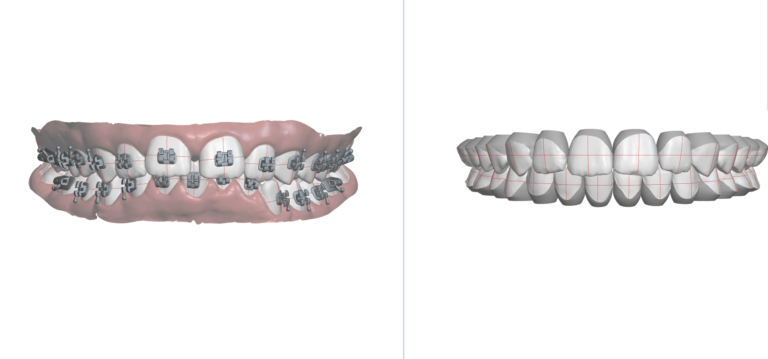
An overbite means the upper teeth extend too far over the lower ones. An open bite means some upper and lower teeth never touch when the mouth is closed. Different causes, different treatment.
What is an overbite, and when does it need treatment?
In a healthy bite the upper teeth overlap the lower teeth slightly. With an overbite malocclusion the upper jaw extends further than the lower, and depending on severity it can make eating and chewing difficult. In deeper cases the lower teeth meet the roof of the mouth.
What causes it
Overbites are usually a jaw-size relationship — the upper and lower jaws are not proportionate — and childhood habits can contribute. A related pattern, protrusion or overjet (‘buck teeth’), comes from underdeveloped jaw bones or thumb sucking, and pushes the upper front teeth outward.
Why it is worth correcting
- Front teeth that take the full force of the bite wear down unevenly
- Protruding upper front teeth are more exposed to trauma in sports and falls
- Chewing efficiency drops when the back teeth are not doing their share
- Jaw and facial tension can follow from an unbalanced bite
What is an open bite, and why is it harder to treat?
With an open bite, some top teeth do not meet the bottom teeth when the mouth is closed — either in the front or at the back. Chewing food properly and pronouncing certain words can be genuinely difficult, and the facial structure is typically affected.
Skeletal versus habit-driven open bites
An open bite may result from skeletal development problems, from childhood habits such as thumb sucking and tongue thrusting, or from both. That difference drives the plan: a habit-driven open bite in a growing child can often be intercepted, while a skeletal open bite in an adult may require surgical orthodontics alongside braces.
Why early treatment matters here
Early orthodontic treatment is especially effective for open bites, because the habit can be addressed and jaw growth guided before the pattern is locked in. Our guides to thumb sucking and mouth breathing in kids cover the two habits that most often show up behind an open bite.
Overbite vs. open bite: how do they compare?
| Overbite | Open bite | |
|---|---|---|
| What you see | Upper front teeth cover too much of the lower teeth | A visible gap between upper and lower teeth when biting down |
| Common causes | Jaw size mismatch; thumb sucking; underdeveloped lower jaw | Tongue thrusting; thumb sucking; skeletal growth pattern |
| Main day-to-day effect | Uneven wear; difficulty chewing in deep cases | Trouble biting into food; speech sounds affected |
| Typical treatment | Braces or clear aligners; appliances in growing children; surgery in severe cases | Braces or clear aligners with habit correction; surgery in severe skeletal cases |
| Best time to intervene | Often manageable in the teen years | Earlier is markedly better, before the habit sets the pattern |
Both sit alongside underbite, crossbite and protrusion on our common orthodontic issues page; if you suspect a crossbite instead, our guide to crossbite types goes deeper.
How are these bites actually corrected?
In growing children
Appliances that guide jaw width and growth, sometimes with a short course of braces for kids, plus habit correction. This is the window where a small intervention prevents a large one.
In teens
Full braces for teens or clear aligners, usually with elastics to correct the bite relationship rather than just straightening the teeth.
In adults
Adult treatment works on teeth that sit in fully formed bone, so severe skeletal discrepancies may need combined orthodontic and surgical planning. Many cases are still fully correctable with braces or aligners alone — the records tell us which.
How are bite problems actually diagnosed?
By records, not by looking in a mirror. Two bites that look similar from the front can be completely different underneath.
What the records show
- A digital scan builds a precise 3D model of both arches and how they meet
- Digital X-rays show root position and unerupted teeth, at roughly an eighth of the exposure of traditional film
- 3D CBCT imaging, where indicated, shows jaw bones, joints, tissues and airway
- A clinical exam adds what images cannot: how the jaw moves, and where teeth touch first
Dental versus skeletal — the distinction that drives everything
A dental problem is teeth sitting wrongly in jaws that are proportionate; a skeletal problem is the jaws themselves being mismatched in size or position. Dental problems are corrected by moving teeth. Skeletal problems in a growing child can often be guided with appliances; in an adult, they may need surgical planning.
What happens if an overbite or open bite is left untreated?
Wear and function
Teeth that carry more than their share of the bite wear faster, and a bite that cannot meet properly makes chewing inefficient — which is why some patients unconsciously chew on one side for years.
Joint and muscle strain
Misalignments that keep the jaw muscles under tension are one recognized contributor to TMJ disorder, along with clenching, trauma and arthritis.
Speech, sleep and confidence
Open bites in particular affect the pronunciation of certain sounds, and habit-driven bites often travel with mouth breathing and disrupted sleep. The self-consciousness that comes with a bite people notice is not a small thing, especially for teenagers.
How is the result kept after treatment?
With retainers, worn as prescribed. Bites that were corrected against a habit — tongue thrust, thumb sucking — relapse most readily if the habit returns, so retention plans for those cases are deliberately conservative. The Lifetime Guarantee covers the case where life happens anyway: if a completed result relapses because a retainer went unworn, Dr. Battle will replace the braces, with a nominal monthly adjustment charge and the cost of a new retainer.
Which appliances and options come up most often?
For children
Expanders and other growth-guiding appliances address arch width and habit correction while the jaws are still developing, often with a short course of partial braces.
For teens and adults
Full braces or clear aligners with elastics do the bite work. Custom 3D-printed brackets with indirect bonding place each bracket precisely, which supports more predictable tooth movement and fewer adjustment visits, and digital treatment planning lets you see the intended outcome before starting.
When surgery enters the conversation
Only for severe skeletal discrepancies in patients who have finished growing, and always as a combined plan with an oral surgeon. It is discussed openly at the consultation rather than sprung later.
FAQ: overbite and open bite
Can clear aligners fix an overbite or an open bite?
Often yes, particularly with attachments and elastics to control the bite. Severe skeletal cases are the exception, and those are identified at the consultation.
Is a slight overbite normal?
Yes. A healthy bite has the upper teeth overlapping the lower teeth slightly. It is the degree, and what it does to chewing and wear, that decides whether it is a problem.
Will an open bite close on its own if the habit stops?
In young children, stopping the habit early sometimes allows substantial improvement. Once permanent teeth and jaw growth have set the pattern, active treatment is normally required.
How do I know which one my child has?
You do not have to. Bring them in for a complimentary exam and we will show you on their own scan and X-rays exactly how the bite is fitting together.
Book a complimentary exam in Winter Springs, Oviedo or Waterford Lakes
Dr. Battle is the area’s only board-certified specialist in orthodontics and dentofacial orthopedics, and has built the practice around complex cases. Request a complimentary exam in Winter Springs, Oviedo or Waterford Lakes for a straight answer on your bite.